

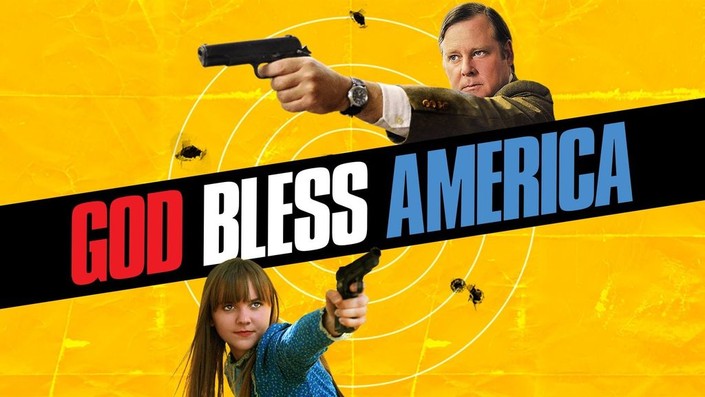
There’s a specific, simmering rage familiar to anyone navigating modern society. It’s the feeling that rises when we’re trapped in a theater with someone’s phone screen glaring, when we overhear neighbors whose actions seem to affect no one but themselves, or when we flip through channels only to find a parade of vapid reality shows celebrating the shallowest and meanest among us. For the terminally fed-up among us, Bobcat Goldthwait’s 2011 film, God Bless America, is the ultimate cinematic fever dream.
Remembered for its shocking, nihilistic violence, the film follows a terminally ill man and his teenage sidekick as they embark on a cross-country killing spree to purge America of its most irritating citizens. But while its reputation is built on a foundation of rage and bloodshed, the story of this polarizing cult classic is far more complex and contradictory than it appears. Here are five of the most surprising and counter-intuitive truths about the angriest film of the 2010s.
——————————————————————————–
1. The Title Is a Bitter Twist on an Immigrant’s Prayer for Peace
The profound irony of the film’s title is its first and most startling contradiction. But the phrase’s origin is the polar opposite of the film’s rage. The song “God Bless America” was written by Irving Berlin, a Jewish immigrant who fled persecution in Russia with his family. The title’s sincerity was personal; it was inspired by his mother who, despite the poverty they faced after fleeing Russian pogroms, would often say the phrase with an emotion that was “almost exaltation.” In 1938, as fascism rose in Europe, Berlin revised an earlier version of the song, stating that he wanted to write a “peace song” as an “expression of gratitude for what this country has done for its citizens.”
To ensure the song was unifying and non-militaristic, Berlin made specific lyrical changes. He replaced the politically charged line, “Stand beside her and guide her to the right with a light from above,” with the more poetic “Through the night with a light from above.” He also removed the phrase “Make her victorious on land and foam” because he wanted to avoid any suggestion of military conquest. The final result was not a declaration of superiority, but a solemn prayer for a “land that’s free.” By slapping this title on a film fueled by homicidal rage, Goldthwait performs a profound act of cultural vandalism, twisting a prayer for peace into a banner for a holy war against bad manners.
2. It’s Not a Revenge Fantasy—It’s a Twisted Plea for Kindness
On the surface, God Bless America is a bloodbath of social commentary. Protagonist Frank Murdoch travels the country with a handgun, executing rude moviegoers, cruel reality TV stars, and hateful political pundits. It’s easy to dismiss the film as a simple revenge fantasy for the perpetually annoyed. But the film’s central paradox is Frank’s ultimate motivation: a desperate desire for decency. Beneath the bloodshed, his mission is shockingly simple: he just wants everyone to be nice to each other.
This violent crusade for etiquette is distilled into the film’s most brilliantly absurd line, a mission statement that is both a punchline and a sincere plea:
“I want to kill people who are mean.”
Frank is a walking contradiction: a liberal man who is disgusted by cruelty but adopts right-wing methods—violent vigilantism—to find a stage to air his liberal views. This internal conflict is what elevates the film beyond a simple rampage. It becomes a commentary on the profound frustration of feeling that civility itself has become so endangered that it requires a violent defense. Frank’s war isn’t against individuals so much as it is against the death of kindness.
3. Its Smartest Critics Argue It Aims at the Wrong Target
While audiences were polarized by the film’s violence, a more nuanced and potent critique emerged from its keenest observers: the film attacks the symptoms of cultural decay, not the causes. Goldthwait’s satire, for all its fury, directs its fire at the easiest and most visible targets, allowing the true architects of our “junk culture” to go unscathed.
As one analysis points out, the film’s protagonists target the “bratty airhead” from a reality TV show but let the “Viacom executive who green-lit the show” off the hook. This is a significant flaw in its satirical mission. By focusing on individual bad behavior, the film avoids asking “bigger questions about corporations and government” and the systemic forces that produce, package, and monetize the very stupidity it claims to despise. For these critics, the film’s rampage functions more as an immediate, cathartic release for audience frustration than as a truly effective piece of systemic political satire. It gives us the satisfaction of seeing the puppets punished, but never pulls back the curtain to reveal the puppeteers.
4. The Director Was a Famous 80s Comedian (And He Wasn’t Screaming)
The furious, articulate, and almost prophetic voice behind God Bless America belongs to a man most of the public knew for an entirely different kind of noise. The film’s writer and director is Bobcat Goldthwait, the comedian famous for his 1980s persona as the “screeching weirdo” from the Police Academy movies. His signature act was a strangled, high-pitched, almost incoherent stream-of-consciousness delivery that made him a unique, if jarring, fixture of the decade.
This public image makes his role as the creator of God Bless America all the more surprising. In his real life as a director, Goldthwait is “actually quite soft-spoken and articulate.” This contrast reveals the film’s rage not as an impulsive scream, but as a controlled, articulate, and deeply considered polemic from an artist who had been observing the cultural decline from behind a mask of chaotic comedy. It reveals a depth and cultural insight that was always there, just waiting for the right moment—and the right volume—to be heard.
5. The Film Was Almost Designed to Be Divisive
The critical reception for God Bless America was all over the map, a testament to its polarizing power. It was called both “Fiercely funny, savage and wise” and, conversely, “awful” with an “obvious agenda to sway public opinion.” This division was not a bug, but a feature. As one reviewer who sat “on the fence” noted, he could see “why a lot of people might love this film, as I can also see why some would find it a complete disappointment.”
The film acts as a cultural Rorschach test. A viewer’s reaction to Frank’s rampage—whether they cheer, cringe, or both—says as much about their own frustrations with society as it does about the film’s artistic merit. The Rorschach test is this: Do you, like Frank, see the problem in the spoiled teenager and the rude moviegoer? Or do you, like the film’s smartest critics, see the true sickness in the invisible systems that profit from their behavior? The film’s divisive genius is that it never answers, forcing the catharsis or the critique to come from us.
Conclusion: A Flawed, Furious, and Unforgettable Warning
God Bless America is far more than its violent premise. It’s a complex, flawed, and deeply thought-provoking satire born from a palpable frustration with the cruelty and vapidity of American culture. Behind its shocking title is a history of immigrant hope, its violent crusade is a twisted plea for kindness, and its satirical aim is both sharp and frustratingly narrow. That this furious sermon was delivered by an artist most remembered for a comedy routine of incoherent screaming is the film’s final, most surprising irony. God Bless America is not a mirror, but a funhouse distortion—one that forces us to question if the grotesque reflection is any less true.
More than a decade after its release, the film’s central question remains: in a world that feels increasingly cruel and shallow, where is the line between righteous anger and the very indecency we claim to oppose?
Discover more from Entertainmentnutz
Subscribe to get the latest posts sent to your email.
