

1.0 Introduction: The Rage of the Everyman
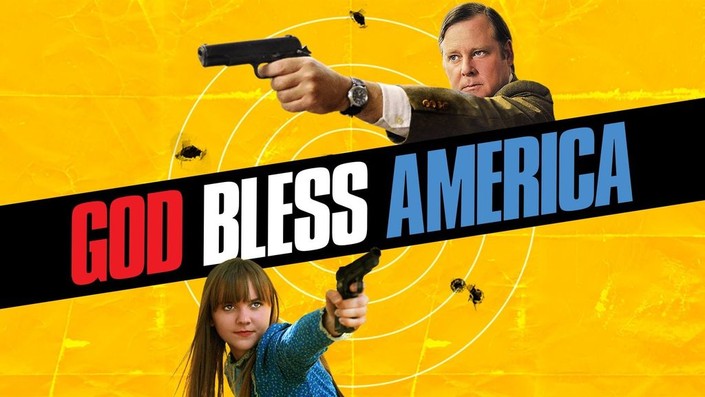
Bobcat Goldthwait’s God Bless America (2011) is less a movie than a Molotov cocktail lobbed into the heart of early 21st-century American culture. It is a film that wears its disgust on its sleeve, presenting a volatile mix of dark comedy and violent social commentary aimed squarely at the perceived degradation of modern life. This essay will argue that the film serves as a divisive but potent polemic, analyzing how its cathartic violence, polarizing characters, and uneven tone contribute to its mixed but undeniably impactful legacy.
The film’s premise is brutally simple. It follows Frank Murdoch (Joel Murray), a middle-aged, divorced, and downtrodden insurance salesman who, after being fired and receiving a terminal diagnosis, reaches his breaking point. Overwhelmed by the cruelty, stupidity, and incivility he sees permeating society—from obnoxious neighbors to vapid reality television—Frank abandons his suicide plan in favor of a new mission: to rid America of its most repugnant citizens. Armed with a gun and a righteous fury, he embarks on a cross-country killing spree, soon joined by an unlikely teenage accomplice, Roxy Harmon (Tara Lynne Barr), who shares his misanthropic rage.
Ultimately, God Bless America remains a critical touchstone precisely because of this tension; lauded for its “scathing indictments of society,” its legacy is equally defined by a “preachy” execution and narrative flaws that make it a powerful, if imperfect, polemic whose message and method are in constant debate. This very friction is what makes it a compelling subject of analysis, beginning with the vast cultural cesspool it seeks to drain.
2.0 The Satirical Cesspool: Critiquing a Culture of Cruelty
The strategic importance of the film’s social critique cannot be overstated; it is the engine that drives the entire narrative. Goldthwait uses Frank’s exasperated perspective as a launching pad for a broadside attack against what one reviewer aptly describes as our “self-centred, celebrity-obsessed, uncritical age.” Frank is not merely a killer; he is a vessel for a specific, articulate rage against the decline of decency and the celebration of ignorance. The film methodically identifies and executes its targets, cataloging the myriad frustrations of modern life before dispatching them with brutal finality.
The primary targets of the film’s satire, as identified across numerous critical reviews, are a comprehensive indictment of a society Frank believes has lost its way.
- Reality Television: The film reserves special contempt for what it sees as the nadir of entertainment. It directly lampoons “American Idol type singing competitions” with its fictional stand-in, “American Superstarz,” and savages reality shows featuring “spoiled rich kids” who are famous for being awful.
- Political Discourse: Goldthwait takes aim at the toxic nature of modern media, targeting “political commentators who just scream fear” and “right-wing religious nuts who protest funerals.” The film portrays a media landscape built on division and outrage rather than substantive conversation.
- Media and Celebrity Culture: At its core, the film attacks a culture that, in a line highlighted by the Ben Dover Flix review as a “Famous Quote from the Movie,” rewards “the shallowest, the dumbest, the meanest and the loudest.” It is a protest against a world where fame is divorced from talent and bestowed upon those who can generate the most noise.
- Social Incivility: Beyond the grand targets, the film’s rage extends to the thousand tiny cuts of everyday rudeness. Frank and Roxy’s hit list includes “loudmouths,” “inconsiderate” neighbors who block his car, people “talking on their cell phone in a movie theater,” and rude double-parkers.
One reviewer, johnnyboyz, offers a more academic observation, framing the film’s critique as a commentary on America’s fundamental shift from a “‘print’ based society to an ‘image’ based society.” In this view, the culture has severed itself from “nuanced thought” and the “struggle with ambiguity,” opting instead for the simple gratification of “jargon and clichés.” This analysis elevates the film’s spree from a mere collection of grievances to a violent reaction against a perceived intellectual and moral decay.
Having established the cultural landscape under fire, the effectiveness of this critique rests on the shoulders of the two characters carrying out the assault: Frank and Roxy.
3.0 The Unlikely Crusaders: An Analysis of Frank and Roxy
The success or failure of God Bless America‘s message is intrinsically tied to the audience’s perception of its protagonists. Frank and Roxy are not simple heroes or villains; they are presented as both cathartic avengers for a frustrated populace and deeply flawed individuals whose methods are as questionable as the culture they condemn. Their dynamic is the film’s central relationship, and the critical response to them is as divided as the reaction to the film itself.
3.1 Frank Murdoch: The Contradictory Anti-Hero
Frank Murdoch is the film’s “broken anti-hero,” a “downtrodden sad sack” who transforms into the unlikely vessel for the film’s simmering rage. He is positioned as an everyman, pushed to the brink not by a single dramatic event but by the slow, grinding erosion of a society he no longer recognizes. Joel Murray’s performance is widely praised, with reviewers noting that he “delivers a perfect performance as one of the last thinking men” and brings “weight, compassion, and conviction to the lead role.”
The character is defined by his internal conflict. One critic astutely identifies him as a “walking contradiction, a liberal man who fights his cause with right-wing methods to find a stage to air his liberal views.” This paradox is central to the film’s polemic, but as another critic points out, it reveals a deeper hypocrisy: Frank is “just as weak and lost in our ‘uncivilized society’ as anyone else,” failing to “turn off the shrieking TV and read a book” or assert himself in any meaningful way “until he does so through violence.” He despises cruelty yet becomes a mass murderer, forcing the audience to grapple with whether his intentions, however noble, can ever justify his horrific actions.
3.2 Roxy Harmon: The Polarizing Accomplice
If Frank is the film’s conscience, Roxy is its id—an energetic, unhinged, and deeply polarizing force. Her introduction marks a significant shift in the narrative, and critics are sharply divided on her effectiveness. For some, Tara Lynne Barr’s performance is a “revelation,” and the character is seen as “ridiculously hilarious and downright terrifying all at the same time.” For others, Roxy “quickly becomes quite grinding,” with her character feeling “faulty and forced” and ultimately “annoying.”
This critical divide reflects her narrative impact. Her arrival is not just a narrative shift; it is the catalyst for the film’s primary satirical failure. One reviewer argues that after Roxy appears, the movie “loses its focus” and “falls into several paradoxes.” She expands the killing spree to include trivial targets—such as people who high-five—blurring the film’s righteous anger against systemic decay into petty grievance against matters of “taste rather than appropriate satire.” This is further complicated by the late-film reveal that she lied about her background, inventing an abusive home life to escape her “wholesome, middle-class” parents and a life of “bland conformity,” a deception that further muddies the film’s unstable moral compass.
The tension between Frank’s focused rage and Roxy’s chaotic impulses is not merely a character dynamic; it is the central fracture line that runs through the film’s very execution, splitting critical opinion on whether it is a focused polemic or an undisciplined rant.
4.0 Genre and Execution: A Darkly Comic Polemic or a Flawed Rant?
The critical debate surrounding God Bless America extends deeply into its very identity. Its classification is unstable, with reviewers alternately describing it as a “subversive comedy,” a “slightly disappointing drama,” a “darkly comic polemic,” and, most bluntly, an “extended rant.” This confusion speaks to the film’s tonal inconsistencies and its struggle to balance savage humor with its serious, often preachy, message. The result is a film that some find brilliant and others find grating, its strengths and weaknesses inextricably linked.
This duality is evident in the specific points of praise and criticism levied by reviewers.
| Perceived Strengths | Perceived Weaknesses |
| Biting Social Commentary: Praised for “intelligent and right on” commentary and “cracking monologues.” | Overbearing Preachiness: Criticized for its reliance on “soliloquy,” feeling like a “rant by an angry liberal.” |
| Cathartic Appeal: Described as a “revenge fulfillment journey” and a satisfying “medication to your frustrations.” | Narrative Flaws: Noted for having “no real set direction,” pacing issues, and being “uneven and somewhat thin.” |
| Dark Humor: Characterized as “fiercely funny,” “agreeably acerbic,” and having “bitingly funny” dialogue. | Unfocused Satire: Accused of targeting people for minor annoyances like “high fives,” making it about “taste rather than appropriate satire.” |
| Strong Lead Performances: Joel Murray and Tara Lynne Barr’s acting is frequently cited as a highlight. | Tonally Inconsistent: Described as a film where some scenes are “scorchingly well-executed, while others land with a thud.” |
To better understand its place in cinematic history, critics frequently contextualize God Bless America by comparing it to other films about societal breakdown and vigilante justice. It is often mentioned alongside Falling Down (1993), though Goldthwait’s film is frequently seen as a less “visceral” take. However, some argue this was a deliberate artistic choice, with one commenter noting the film “settled on a slow burn” rather than the single-day explosion of its predecessor. It has been called an “answer to” Oliver Stone’s Natural Born Killers, which glorified spree killers as celebrities, whereas Frank and Roxy lament not even making the news. Other common touchstones include the urban alienation of Taxi Driver, the dark vigilantism of Super, and the media satire of Network, with one reviewer labeling God Bless America a “B-movie version” of that 1976 classic.
These comparisons highlight the film’s ambitious-yet-flawed nature, positioning it within a tradition of angry cinema while also underscoring its unique, and often messy, execution.
5.0 Conclusion: The Enduring Resonance of a Divisive Film
In the final analysis, God Bless America stands as a provocative and deeply polarizing work of social satire. It channels a palpable rage against the perceived idiocy and cruelty of modern American culture, using a terminally ill insurance salesman and his teenage accomplice as the bloody instruments of its critique. As this essay has argued, its reliance on cathartic violence, its contradictory protagonists, and its tonally inconsistent execution have left it with a complicated and contested legacy.
The film’s official critical reception confirms this division, with “mixed or average” reviews leading to a 66% Tomatometer score on Rotten Tomatoes and a 56 on Metacritic. Yet, these numbers fail to capture the passion it inspires. For every critic who dismisses it for its “preachiness” or narrative “sludge,” there is a viewer who hails it as a necessary release valve, a “fantasy for us grumpy old men” that articulates a deep-seated frustration with contemporary incivility. This resonance persists even through a nihilistic climax, where the revelation of Frank’s misdiagnosis renders his crusade tragically unnecessary, culminating in a “Bonnie and Clyde style” shootout that offers no redemption, only a final, bloody statement.
Ultimately, God Bless America‘s enduring value is not as a perfect film, but as a “fiercely funny, savage and wise” cultural artifact. It is messy, contradictory, and often heavy-handed. More than a decade after its release, its imperfect, furious howl has become more, not less, relevant in an era where the cultural trends it satirized have accelerated from the fringe into the mainstream, ensuring its place as a necessary, if flawed, satirical gut-punch.
Discover more from Entertainmentnutz
Subscribe to get the latest posts sent to your email.
