

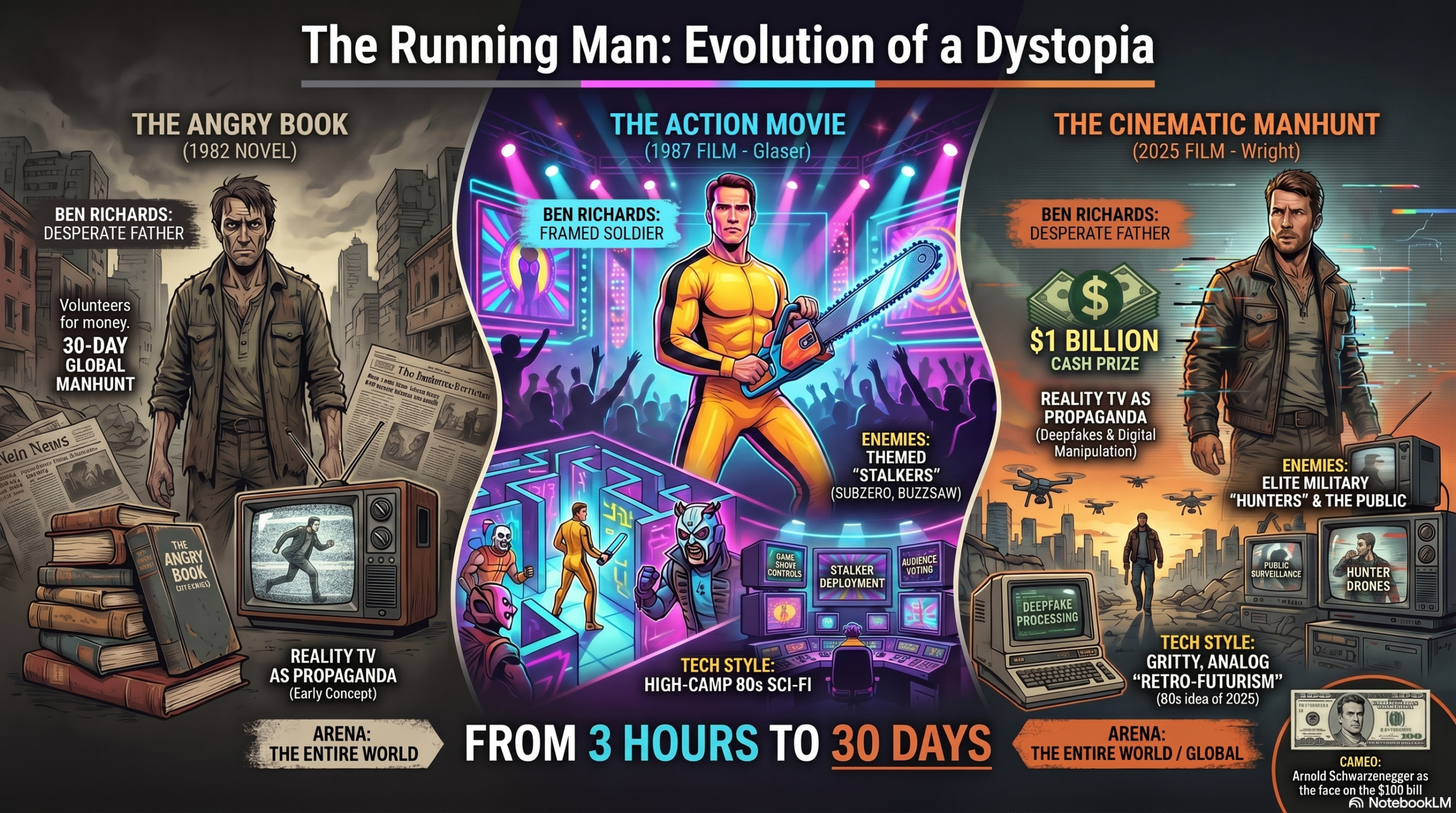
In the annals of dystopian cinema, few properties have undergone as radical a transformation as The Running Man. Separated by a 38-year chasm, Arnold Schwarzenegger’s 1987 “Butcher of Bakersfield” and Glen Powell’s 2025 desperate laborer represent two distinct transmissions from a collapsing future. Both find their DNA in Stephen King’s 1982 novel—written under the “Richard Bachman” pseudonym as a scathingly anti-establishment thriller—yet they diverge so wildly in execution they feel like they belong to different genres entirely. While the 1987 version leaned into the technicolor artifice and muscle-bound spectacle of its era, the 2025 reimagining, directed by Edgar Wright, attempts a gritty reclamation of the source material’s marrow.
From Forced Captivity to Desperate Volunteering
The pivot point of any Running Man adaptation is the soul of Ben Richards. In the 1987 production, Richards is a military pilot framed for a massacre after refusing to fire on a food riot. He is a captive gladiator, forced into the game as a death row sentence. Conversely, the 2025 Richards (Powell) is a blacklisted union activist living in the shadows of Co-Op City. Driven by the crushing inability to afford flu medicine for his two-year-old daughter, he chooses to volunteer for the lethal reality show.
This shift provides the 2025 version with an emotionally resonant foundation grounded in economic desperation rather than the “deep legal drama” of a frame-up. As screenwriter Michael Bacall observed, the goal was to keep Ben’s emotional core intact from the Bachman text: “We both responded to that aspect of Ben hating bullies… We love that rebellious aspect of him, which gives him his strength, but is also a fatal flaw.”
The Arena: A Gladiatorial Sprint vs. a Global Hunt
The geography of the hunt has mutated significantly. The 1987 film contains the action within a 400-block “industrial zone”—an earthquake-ruined section of Los Angeles that serves as a high-tech playpen for television cameras. It is a 3-hour gladiatorial sprint.
Wright’s 2025 version restores the novel’s global scale and agonizing temporal tension. Here, the entire world is the game zone. Richards is given a 12-hour head start and must survive for 30 days while being tracked by both professional killers and ordinary citizens incentivized by cash rewards. There is a new, intrusive rule: Ben must film himself every day to collect his prize, turning his survival into a mandated piece of content for a surveillance state.
Wright’s cinematic lineage is on full display here; the director explicitly noted that his film “works on Walter Hill’s side of the street,” drawing heavily from the urban quest-narratives of The Warriors and the desperate atmosphere of John Carpenter’s Escape from New York. The action adopts a Hitchcockian texture, balancing “big problems”—evading heavily armed Hunters—with “small problems” that heighten the stakes of survival. In one standout sequence, a naked Richards must use a towel to muffle the sound of his fist breaking through glass to avoid detection, a visceral detail that grounds the sci-fi in raw, physical reality.
Stalkers vs. Hunters: Wrestling Gimmicks vs. Military Precision
The antagonists in each film reflect the media anxieties of their respective times. The 1987 “Stalkers” were larger-than-life wrestling personas—Subzero, Buzzsaw, and Dynamo—who used flamboyant weapons like electric suits and chainsaws. They were exercises in pro-wrestling theatricality, designed for an audience craving colorful, choreographed violence.
In contrast, the 2025 “Hunters” are a tight-knit, anonymous military team. They are led by Evan McCone (Lee Pace), a character who serves as a chilling foil to Richards; McCone is a former runner who survived by taking the Network’s deal. While the 1987 villains were gimmicks to be dispatched with a pun, the 2025 Hunters represent the cold, efficient arm of a corporate-authoritarian state that views human life as an expendable line item.
Retro-Analog vs. Neon-Synth Aesthetics
Visually, the films occupy opposite ends of the science-fiction spectrum. The original 1987 version is a “neon paint factory” of 80s aesthetics, characterized by yellow spandex and a pulsing synthesizer soundtrack by Harold Faltermeyer.
Wright’s 2025 film opts for a “steampunky” retro-futurism. To avoid the visual boredom of modern smartphones, Wright utilized “analog technology” as a plot device. This choice allows the underground resistance to avoid digital surveillance, communicating via zines and antiquated hardware. The world-building is rich with texture, from the fictional reality show “The Americanos” to the “Triple Christ Energy Wine” sold as street liquor. In a clever nod to the property’s history, the face on the “New Dollars” currency is none other than Arnold Schwarzenegger himself—a meta-wink to the man who first brought Richards to the screen.
The Ending: Disproving the Digital Lie
The tone of each film’s resolution highlights the shifting goals of the adaptations. The 1987 film concludes with a straightforward Hollywood triumph: Richards takes over the ICS studio via a satellite override, kills the host Damon Killian, and kisses the leading lady as the truth is broadcast. It is a victory of the individual over the machine.
The 2025 version enters the more treacherous territory of media manipulation. Here, the Network uses deepfake technology to turn the public against Ben and eventually fakes his death in a plane crash. The 1987 version was about broadcasting the truth; the 2025 version is about disproving a digital lie. The film attempts to inject a sense of “revolutionary hope,” culminating in a leaked recording that incites a massive rebellion.
Stephen King famously praised this new adaptation as “Die Hard for our time!” However, the shift from the novel’s nihilistic ending—where Richards flies a plane into the Games Building—to a more optimistic finale has drawn scrutiny. Critic Joe George described the 2025 resolution as “gauzy feel-good nonsense” compared to the raw, suicidal anger of the original Bachman text.
Conclusion: The Reality TV Mirror
Both versions of The Running Man serve as biting satires, but they reflect different mirrors. The 1987 film was a prescient critique of the rise of bloodthirsty entertainment. The 2025 film, however, seems to have caught up with our actual reality—a world of extreme income gaps and corporate surveillance where the dystopian fiction of 1982 feels uncomfortably like a documentary.
Whether you prefer the muscle-bound hero of the 80s or the desperate, rugged father of the modern era, both films ask the same haunting question: in a world that thrives on watching others suffer, who is the real monster—the runner or the audience? As we navigate our own era of reality TV and deepfakes, it is worth wondering if we are no longer watching the game, but living inside the arena.

The 1987 and 2025 film adaptations of The Running Man differ significantly in their tone, rules, and character motivations. While the 1987 version is a campy 1980s action blockbuster, the 2025 film, directed by Edgar Wright, aims to be a much more faithful adaptation of Stephen King’s original 1982 novel.
Here are the biggest differences between the two versions:
Ben Richards’ Backstory and Motivation
- 1987: Arnold Schwarzenegger’s Ben Richards is a military helicopter pilot who is framed for massacring innocent civilians. He is forced to play the game as a form of execution and to protect his friends.
- 2025: Glen Powell’s Ben Richards is a blacklisted union activist who voluntarily enters the game to win the massive $1 billion cash prize so he can afford flu medicine for his dying infant daughter.
The Game’s Arena and Duration
- 1987: The game lasts for only three hours and is confined to a 400-block underground arena made of earthquake ruins. The prize for surviving is theoretically a legal pardon and a free trip to Hawaii.
- 2025: The game is a 30-day survival challenge where contestants can run anywhere in the real world. The outside world is actively involved, as the network incentivizes ordinary citizens to report the runners’ locations for cash.
The Villains
- 1987: The runners are hunted by “Stalkers,” who are larger-than-life, wrestling-style gladiators with colorful personas and gimmicky weapons, such as a chainsaw-wielding biker and a man who shoots electricity.
- 2025: The “Hunters” are a tight-knit, anonymous military-style team led by a masked man named Evan McCone.
The Network Executives
- 1987: The roles of the evil network producer and the charismatic TV host are combined into a single character, Damon Killian, famously played by real-life Family Feud host Richard Dawson.
- 2025: The roles are split between two characters: Dan Killian (Josh Brolin) serves as the manipulative executive producer, while Bobby T. (Colman Domingo) serves as the energetic host who works the crowd.
Tone and Visual Style
- 1987: The film is celebrated for its campy, lighthearted tone, cartoonish violence, and Arnold’s trademark one-liners.
- 2025: The remake is much darker, angrier, and grittier, focusing heavily on class conflict and desperation. Director Edgar Wright utilized a “retro-futuristic” aesthetic featuring analog technology to make the film look like an 1980s vision of the year 2025. The film’s action is also highly kinetic, utilizing reality-TV-style camerawork inspired by shows like The Kardashians.
Love Interests
- 1987: Ben has a forced, somewhat awkward romance with Amber Mendez, an innocent woman he initially takes hostage.
- 2025: Ben is deeply devoted to his wife, Sheila, and their child, which provides a much stronger and clearer emotional anchor for his actions throughout the film.
Discover more from Entertainmentnutz
Subscribe to get the latest posts sent to your email.